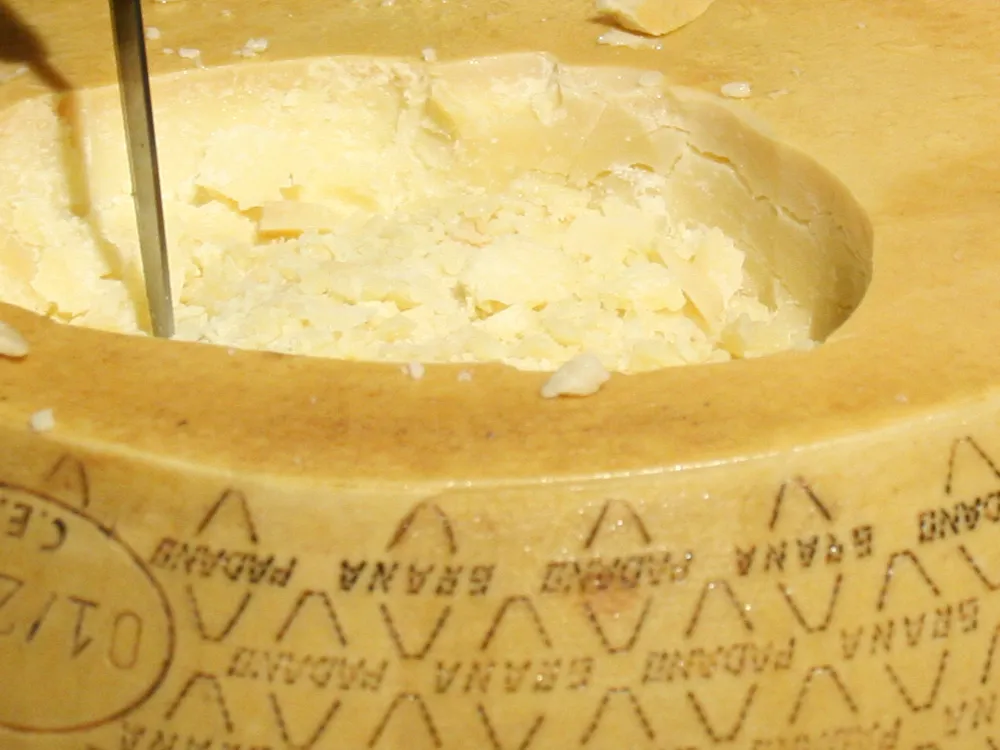
Grana Padano
Grana PadanoisanItalian cow’s milk cheesethat has been enjoyed for centuries.It is a hard cheese with a pale yellow color and a firm, crumbly texture. Grana Padano is often compared toParmigiano Reggiano, another famous Italian cheese, but it has its own unique flavors and characteristics. It is named after the Grana (grainy) texture of the cheese and the Padano region in northern Italy, where it originated. Grana Padano cheese has been produced for almost 1,000 years and is one of the most popular and widely consumed cheeses that has ever received theProtected Designation of Origin (PDO) status. Grana refers to a family of demanding, hard-working, mature cheeses from Italy with a granular, flaky texture and is mainly used for grating. Around the world, Grana is a generic term used to define three main varieties of cheeses, namely - Parmigianino Reggiano, Grana Padano, and Grana Trentino, and other smaller variants like Granone Lodigiano, Trentingrana, and Gransardo. However, the word 'Grana' is legally protected by Grana Padano Protected Designation of Origin in Europe. Only Grana Padano can use the term to sell its produce in EU countries. Of course, Parmigiano Reggiano and Grana Padano are the most popular Grana Italian cheeses. True Parmigianino Reggiano, named after the Provinces of Parma, Reggio Emilia, Modena, Bologna, and Mantua, where it is produced, has a hard, gritty texture and is fruity and nutty in taste. On the other hand,Grana Padanorefers to the valley Pianura Padana, where it is made. Though similar to Parmigianino Reggiano, young Grana Padano is slightly less crumbly, milder, and less complex than its famous, aged kin. Grana Trentino follows the same method to produce Parmigianino Reggiano but is made in the province of Trento, giving it its name. All three main varieties of Grana cheese carry the label DOP (Denomination of Protected Origin), guaranteeing their authenticity and the origin of their production methods. Grana Padano is made from unpasteurized cow's milk.The milk is usually sourced from the Po River Valley in northern Italy, where the cows graze on lush green pastures. It is important to note that Grana Padano does not contain any animal rennet, making it suitable for vegetarians. The production of Grana Padano cheese is a time-honored, process that follows strict guidelines to ensure its quality and authenticity. After the milk is collected, it is heated and mixed with whey and natural whey culture, which kickstarts the fermentation process. Once the curds have settled, they are molded into large wheels and immersed in a brine solution to enhance the flavor and preserve the cheese. The wheels are then aged for a minimum of 9 months, during which time they are regularly turned and monitored for quality. The result is a delicious and versatile cheese with a rich, nutty flavor and a crumbly texture, perfect for grating over pasta or enjoying on its own. Some varieties are left to age for up to 24 months or more, which creates a firmer, more granular texture that becomes crumbly as it ages. The flavor also matures, bringing savory, nutty, and slightly sweet notes to an already flavorful cheese. Grana Padano has a pale yellow or straw-colored interior with a natural rind. It is available at different ripening stages: Grana Padano (9 to 16 months), Grana Padano oltre 16 mesi (over 16 months), and Grana Padano Riserva (over 20 months). All three main varieties of Grana cheese carry the label DOP. (Denomination of Protected Origin), guaranteeing their authenticity and the origin of their production methods. No, most, Grana Padano is made from raw, unpasteurized milk.This means that the milk used in the cheese production process hasn’t been heated to kill harmful bacteria. Grana Padano is a complex hard, slow-ripened, semi-fat cheese from the Po River Valley in northern Italy. It is often compared toParmigiano Reggiano, another famous Italian cheese, but Grana Padano has its unique characteristics. The cheese is aged for a minimum of nine months, during which time it develops a granular texture and a nutty, slightly sweet flavor. Grana Padano is a versatile cheese that can be enjoyed in various ways. It can be grated over pasta dishes, salads, and soups, adding a rich umami flavor. The cheese can also be enjoyed independently, paired with fruits, nuts, or a drizzle of honey. Additionally, Grana Padano pairs well with wines, making it a popular choice for cheese boards and wine tastings. Grana Padano is classified as a grating cheese, which means it is often used to enhance the flavor of various dishes.It is generally aged for 16- 20 months. However, some wheels spend as long as 24 months maturing whilst others are considered ready for market after only nine. This process helps build complexity and richness into the cheese. Grana Padano cheese is a hard, granular cheese originating in northern Italy's Po River Valley. It is made from partially skimmed milk that is heated and curdled before being molded into large wheels and immersed in a brine solution. The cheese is then aged in temperature-controlled rooms, where it develops its unique flavor profile. One of Grana Padano's distinguishing characteristics is its versatility in the kitchen. It can be grated over pasta dishes, blended into risottos, or sprinkled over salads to add a nutty and savory flavor. The cheese can also be enjoyed on its own, paired with fruits, nuts, and honey for a simple yet elegant appetizer. Grana Padano is incredibly versatile and can be used in a wide range of dishes.It can be enjoyed on its own as a cheese course, grated over pasta or risotto, or shaved on top of salads. Its nutty, savory flavor pairs well with both sweet and savory ingredients. One of the most common uses is grating Grana Padano over dishes like pasta, risotto, soups, salads, and vegetables. The hard, grainy texture makes it ideal for grating into thin shavings or coarse pieces to add a savory, nutty flavor. Grana Padano can be enjoyed on its own as a snack or part of a cheese plate. Cut into small cubes or wedges, it pairs well with fruits like grapes or figs, cured meats, olives, and bread or crackers. The cheese can be incorporated into various cooked dishes: Grana Padano is often melted and incorporated into sauces or used as a topping for pizza or bruschetta. Its intense flavor adds depth and richness to any dish. The possibilities are endless when it comes to incorporating Grana Padano into your culinary creations. One classic Italian dish that showcases the deliciousness of Grana Padano is the famous Risotto alla Milanese. This creamy saffron-infused risotto is finished with a generous amount of grated Grana Padano, which not only enhances the dish's creaminess but also adds a wonderful umami flavor. Moreover, Grana Padano can also be used in unconventional ways, such as in desserts. Try grating some over a slice of honey-drizzled pear or apple for a unique sweet and savory flavor combination that will tantalize your taste buds. The hard rind of Grana Padano can be added to soups, stews or beans while cooking to infuse a savory, nutty flavor. It can also be crisped up in the microwave and eaten as a snack. The origins of Grana Padano cheese can be traced back to the 12th century in the Po Valley region of northern Italy, particularly to the Chiaravalle Abbey near Milan.Grana Padano is also produced in the Lombardy, Piedmont, Trentino-Alto Adige, and Veneto regions.The strict production guidelines ensure that the cheese is made using traditional methods, resulting in a high-quality product that is beloved. The production of Grana Padano dates back almost 1000 years, with the first records of its existence found in the 12th century when Cistercian monks in the Po Valley looked for a way to preserve surplus milk from their dairy farms. Over the centuries, the production techniques have been refined and perfected, leading to the world-renowned cheese we know today. Each wheel of Grana Padano is carefully monitored and aged for a minimum of nine months, with some varieties aging for up to 24 months or more. During this aging process, the cheese develops its signature granular texture and complex flavor profile, making it a versatile ingredient in various dishes. Whether grated over pasta, shaved on salads, or enjoyed on its own with a glass of wine, Grana Padano remains a staple in Italian cuisine and a favorite among cheese connoisseurs worldwide. Grana Padano may seem challenging to pronounce, but it is actually straightforward.It is pronounced as "GRAH-nah pah-DAH-no, " (ˌɡrɑːnə pəˈdɑːnəʊ). Remember, practice makes perfect, and once you have the pronunciation down, you'll feel a lot more confident ordering this delicious cheese. Grana Padano and Parmigiano Reggiano are two iconic Italian hard cheeses that share similarities but have distinct differences. While both are made fromcow's milkand aged for an extended period,Grana Padano has a larger production area spanning five northern Italian regions, allowing for a slightly moredelicate and buttery flavorprofile. In contrast,Parmigiano Reggiano is produced in a more localized area and made from a blend of whole and skimmed milk, resulting in a morecomplex, decisive flavor that intensifies with age, developing notes ofcitrus, dried fruit, and hazelnut. The production methods also differ - Grana Padano uses lysozyme as a preservative, while Parmigiano Reggiano relies solely on its natural aging process. Additionally, Parmigiano Reggiano has a minimum aging requirement of 12 months, contributing to its crumbly, granular texture, while Grana Padano can be aged for as little as 9 months, lending it a slightly creamier consistency. These nuances make each cheese unique and suitable for different culinary applications, with Grana Padano often used in cooking and Parmigiano Reggiano prized for grating over dishes. Clickhereto read more about the major differences between Grana Padano and Parmigiano Reggiano! To discover more substitutes for Grana Padano, clickhere! Grana Padano is a remarkable cheese that offers a delightful combination of flavors and textures. Whether enjoyed on its own or used to elevate your favorite dishes, it is a must-try for any cheese lover. Its nutty, savory taste and crumbly texture make it a versatile ingredient that can add depth and richness to a variety of culinary creations. So go ahead and explore the world of Grana Padano, and let your taste buds be delighted by this Italian treasure.
Caracteristiques
- Famille
- Pâte pressée cuite
- Type de lait
- Vache
Valeurs nutritionnelles (pour 100g)
- Calories
- 398 kcal
- Proteines
- 33 g
- Lipides
- 29 g